
Will This Pendant Fit My Chain? A Bail Size Guide
Updated November 2026. By the Jewelry by Sweet Pea team, a family-owned jeweler since 2008.
The short answer: a pendant fits a chain when the end of the chain, usually the clasp or the small ring at the other end, is smaller than the inside of the bail, the loop on top of the pendant. Look for Bail (Inside) in the product details. On our pendants it is most often 2 to 4 mm, and a chain about half a millimeter narrower than the opening slides through freely.
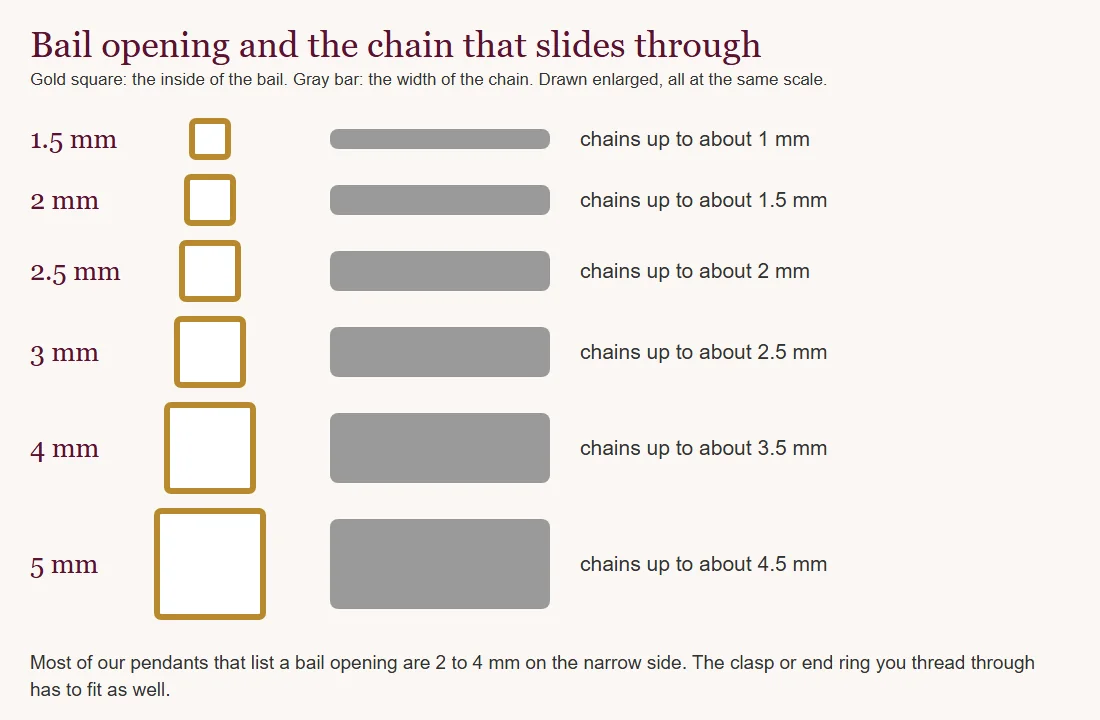
A pendant hangs from a small loop called the bail. To put it on a chain, one end of the chain has to slide through that loop. This guide shows where to find the bail size in our listings, how to measure one at home, and which chains will fit.
What has to fit through the bail?
Two things: the chain itself, and the end you thread through first. One end of a chain has the clasp. The other end usually has a small ring or tag. Both are often wider than the chain, so check the end as well as the chain width.
- Thread the smaller end. Open the clasp and slide whichever end is smaller through the bail. On many chains that is the ring end, not the clasp.
- Leave a little room. A chain about half a millimeter narrower than the opening lets the pendant slide and hang straight.
- Flat chains need more room. A wide, flat chain such as herringbone may not pass through a small bail at all, and it is best worn without a pendant.
How do I find the bail size in a listing?
Look in the product details. Many of our pendants list a line called Bail (Inside). That is the size of the opening, and it is the number to compare with your chain. If it gives two numbers, go by the smaller one.
Some listings show only Bail Width and Bail Length. Those describe the loop itself, not the hole, so the opening is smaller than those numbers. If a listing does not show the inside size, please ask us before you order.
About a thousand of our pendants list the inside of the bail. On the narrow side, about three in four of them are 2 to 4 mm, and the middle size is 2.5 mm.
Bail opening and chain width chart
| Bail opening (narrow side) | Chains that usually slide through | Good to know |
|---|---|---|
| Under 2 mm | Fine chains, about 1 mm and under | Common on small charms. Check the end ring and clasp too, since they are often wider than a fine chain. |
| 2 to 3 mm | Chains up to about 1.5 to 2.5 mm | The most common size on our pendants. Most everyday pendant chains slide through. |
| 3 to 4 mm | Chains up to about 2.5 to 3.5 mm | Room for a medium chain, or a fine chain with a larger clasp. |
| 4 mm and up | Wider chains, about 3.5 mm and up | Room for a bolder rope, curb or wheat chain. |
Chain width is listed in millimeters too. One inch is 25.4 mm, so a 2.5 mm bail opening is about a tenth of an inch.
How do I measure a bail at home?
- Hold the pendant up to the light and find the opening in the bail.
- Lay a ruler with millimeters across the opening and measure the inside, from inner edge to inner edge. Measure the narrow side.
- Measure the widest part of the chain end you plan to thread through: the clasp or the small end ring.
- If the chain end is smaller than the opening, the pendant will go on. If it is very close, choose a slimmer chain or one with a smaller end.
Easier still: if you have the chain at home, gently try the end through the bail. Never force it, since that can bend the bail or the clasp.
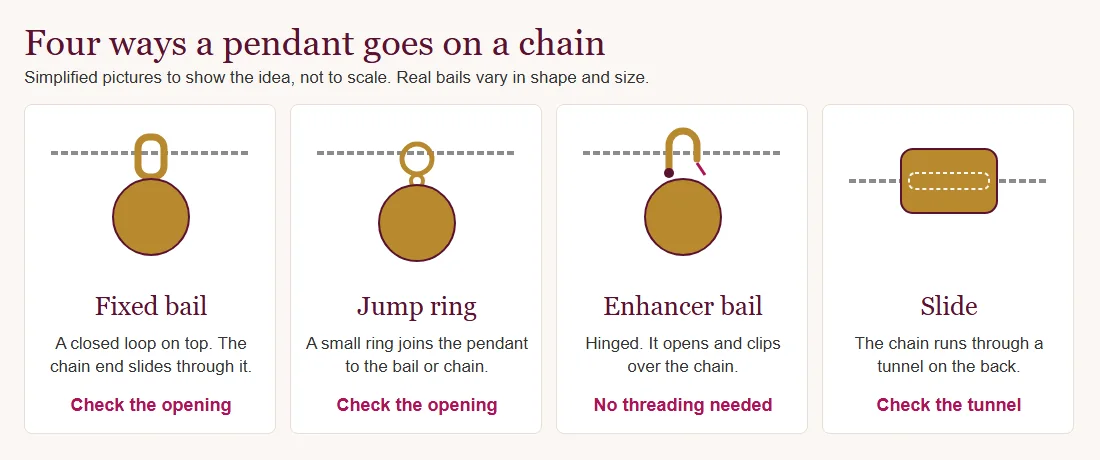
What kinds of bails are there?
- Fixed bail: a closed loop on top of the pendant. The chain end slides through it, so check the opening.
- Jump ring: a small round ring that joins the pendant to its bail or to the chain. It can be small, so check the opening here too.
- Enhancer bail: a hinged bail that opens and clips over the chain. The clasp never has to pass through, so it can go on a wider chain or a chain with a large clasp.
- Slide: the chain runs through a tunnel on the back of the pendant, so the pendant sits close to the chain. Check the size of the tunnel the same way.
Will the chain suit the pendant?
Fitting through the bail is the first check. The chain should also be strong enough for the pendant. A heavy pendant on a very fine chain can flip, twist or wear the chain. Our chain styles guide suggests about 0.5 to 0.8 mm for a small charm, 0.8 to 1.2 mm for a medium pendant, and 1.5 mm and up for a heavy one. Box, cable, wheat and rope chains let a pendant slide freely and hang straight.
A pendant also hangs below the chain. A pendant about 20 mm long, with its bail, sits roughly an inch lower than the chain alone. Our necklace length guide shows where each length sits.
Does a pendant come with a chain?
Many of our pendants are sold on their own, without a chain. Check the product title and the Common Questions in the product details, which say whether a chain is included. If you are buying a chain to go with it, compare the bail opening with the chain width and clasp before you order.
Keep reading and shop
Our blog explains which chain length suits a pendant, when an extender or a new chain is the better fix, and compares box, cable and rope chains. Browse our pendants, pendants and charms, lockets and chains.
More jewelry guides
- How to Find Your Ring Size: Measure at home with our printable sizer and size chart.
- Necklace Length Guide: See where each length sits and try it with a piece of string.
- Gold and Metals Guide: 10K or 14K, sterling silver, plated and more, compared.
- Engraving Guide: How it works, wording tips and what to check before you order.
- Is It Real Gold? A Stamp and Listing Guide: What 10K, 14K, 585, GP and GF mean, and how to check a piece.
- Hoop Earring Size Guide: Hoop sizes in millimeters and inches, side by side, and how to measure.
- Clasp Types Guide: Six common clasps, how each one opens, and how to choose.
- Gold Finishes Guide: Polished, satin, matte, diamond-cut and textured gold, and how to choose.
- Stud Earring Size Guide: Stud sizes in millimeters side by side, what ct tw means, and how to measure.
- Earring Back Guide: Push, screw, locking, lever and hinged backs, how each one works, and how to choose.
- Bracelet and Anklet Size Guide: Measure your wrist or ankle, how much room to add, and the usual lengths.
- Jewelry Care and Cleaning Guide: What is safe for each metal and stone, how to clean at home, and how to store it.
- Birthstone Chart by Month: Every month's birthstone and alternates, how hard each stone is, and which ones suit everyday wear.
- Jewelry for Sensitive Skin Guide: Which metals people with sensitive skin often choose, what causes green marks and irritation, and what to check before you order.
- Chain Styles Guide: Cable, curb, figaro, box, rope, wheat and more side by side, which hold a pendant, and what solid and hollow mean.
- Bangle Size Guide: Measure your hand for a slip-on bangle, convert inches around to inches across, and size hinged bangles and cuffs.