
Hoop Earring Size Chart: How to Choose Your Size
Updated November 2026. By the Jewelry by Sweet Pea team, a family-owned jeweler since 2008.
The short answer: hoops are measured across the outside, in millimeters. 10 to 15 mm hoops (huggies) hug the lobe, 20 mm is a small everyday size, 25 to 30 mm is medium, and 40 mm and up is a statement. 25.4 mm is 1 inch.
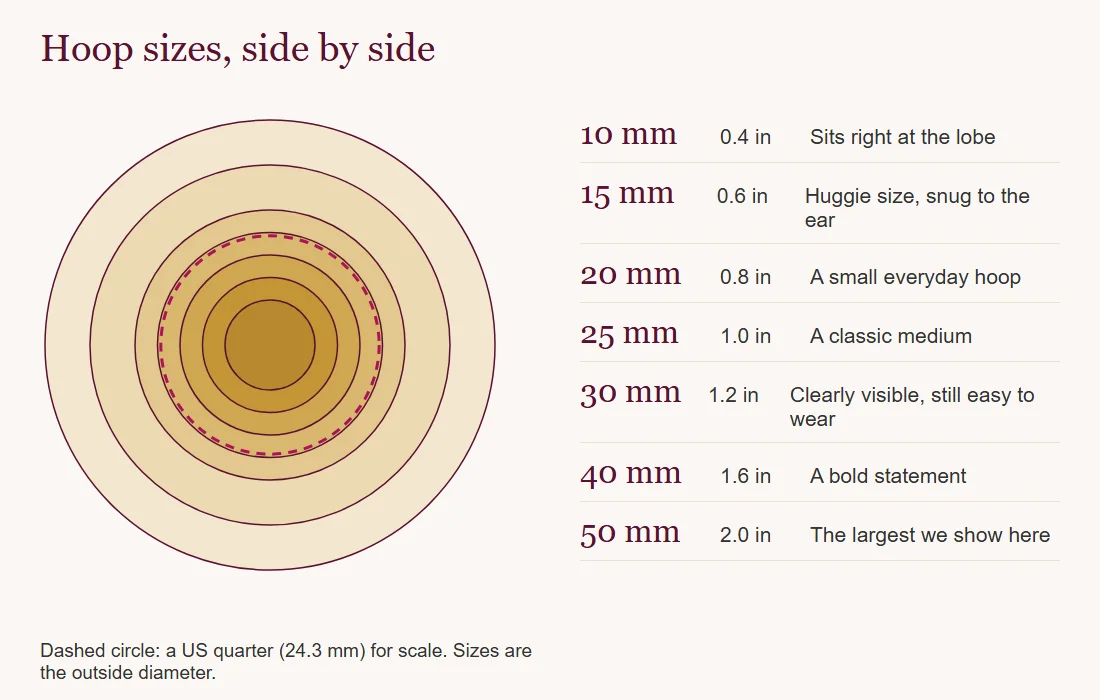
Hoops are sold by diameter in millimeters, and it's hard to picture 20 mm from a number alone. This guide puts the sizes side by side, shows how to measure a pair you already own and tells you what to check in a listing.
Hoop size chart
| Diameter | In inches | What it looks like | Often chosen for |
|---|---|---|---|
| 10 to 15 mm | 0.4 to 0.6 in | Huggies. They hug the earlobe and stay put. | Everyday wear, extra piercings |
| 20 mm | 0.8 in | A small hoop that frames the lobe. | Everyday wear |
| 25 to 30 mm | 1.0 to 1.2 in | A medium hoop that shows clearly without dominating. | Work and dressing up |
| 40 mm | 1.6 in | A bold hoop. | Statement looks |
| 50 mm and up | 2.0 in and up | A large statement hoop. | Statement looks |
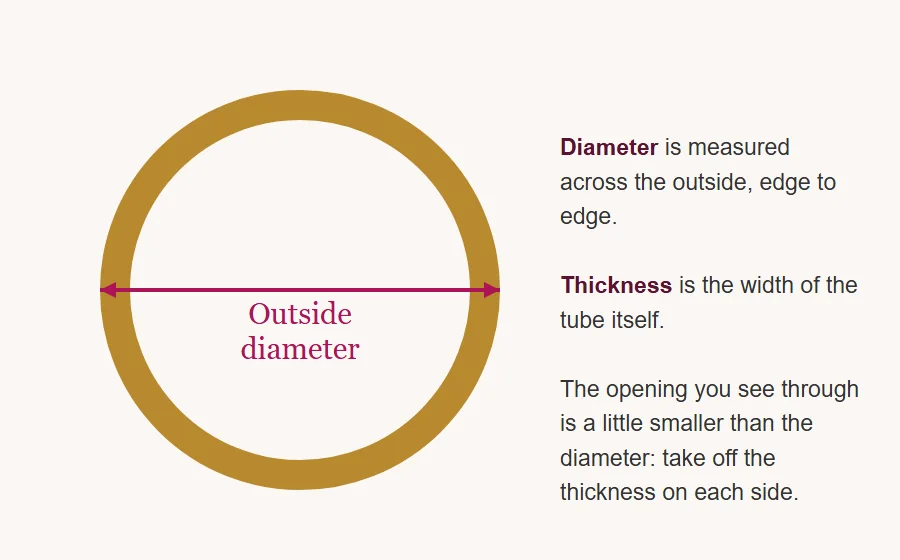
25.4 mm is 1 inch. These are the outside diameter, measured across the whole hoop.
How to find your size
1. Measure a hoop you already like
- Lay the hoop flat next to a ruler with millimeters.
- Measure straight across the outside, from one outer edge to the opposite one.
- Find the closest size in the chart.
2. Compare it with a coin
No ruler? A US coin works. A dime is 17.9 mm across, a penny is 19.1 mm, a nickel is 21.2 mm and a quarter is 24.3 mm. Hold the coin next to your ear in a mirror to see roughly how a hoop of that size would sit.
3. Think about where it will sit
- Close to the lobe: 10 to 15 mm.
- Frames the lobe, easy for every day: 20 mm.
- Hangs below the lobe: 25 mm and larger. The bigger the hoop, the more it shows below your jaw.
Tips for choosing
- Check the thickness as well as the diameter. Two 20 mm hoops can look very different if one is a thin wire and the other a thick tube.
- Read the measurements in the product details. The name of a piece sometimes gives a rounded size, so the listed length, width and thickness are the numbers to go by.
- Hinged or snap closure? Hinged hoops open and close like a gate. Wire and clutch hoops slide through the ear and fasten with a back. Check the closure in the listing.
- Mixing with other earrings? A smaller hoop sits well beside studs, and a large one often looks best on its own.
- Heavy hoops can pull. If your ears are sensitive to weight, look for hollow tubing and check the weight in the listing.
Want to learn more?
Browse our hoop earrings, round hoops and oval hoops, or see our full earring collection. Our guide to earring backs explains the different closures, and statement earrings covers how to wear the bigger sizes.
More jewelry guides
- How to Find Your Ring Size: Measure at home with our printable sizer and size chart.
- Necklace Length Guide: See where each length sits and try it with a piece of string.
- Gold and Metals Guide: 10K or 14K, sterling silver, plated and more, compared.
- Engraving Guide: How it works, wording tips and what to check before you order.
- Is It Real Gold? A Stamp and Listing Guide: What 10K, 14K, 585, GP and GF mean, and how to check a piece.
Hoop Size Questions
What size is a small hoop earring?
How are hoop earrings measured?
How many millimeters is an inch?
What size hoop should I get for everyday wear?
Can you help me choose a size?
Like This Guide?
Join the Sweet Pea Family
Join the list and take $15 off your first order of $100 or more with code SPARKLE15. Plus new arrivals, gift guides and subscriber-only offers — every other week.
Excludes collegiate/LogoArt pieces. Free shipping on everything, always.