Jewelry for Sensitive Skin: How to Choose Your Metal
Updated November 2026. By the Jewelry by Sweet Pea team, a family-owned jeweler since 2008.
The short answer: when jewelry irritates the skin, the cause is often a metal mixed into the piece, most often nickel, so read the metal line in the listing first. Titanium, stainless steel, sterling silver and higher-karat gold such as 14K are the metals people with sensitive skin most often choose. No metal suits everyone, so if you get redness, itching or a rash, take the piece off and ask your doctor.
If a ring leaves a green mark, or an earring makes your ear red or itchy, the metal is the first thing to look at. This guide explains what is usually behind it, which metals people with sensitive skin most often choose, and what to check in a listing before you order. It is general information, not medical advice.
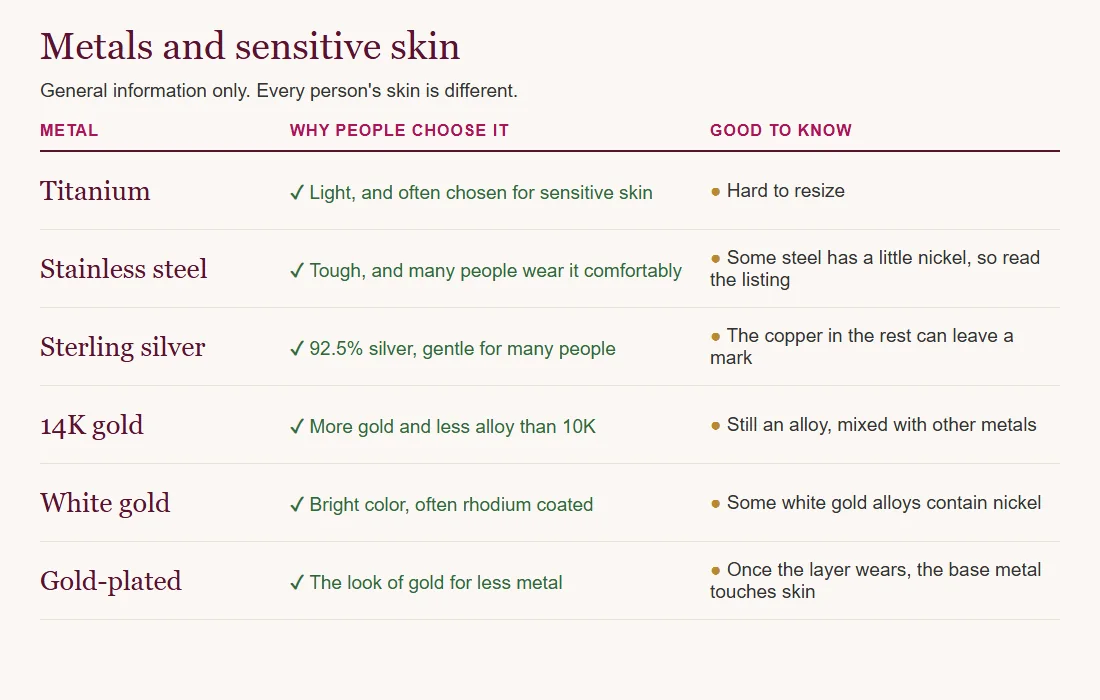
Metals and sensitive skin at a glance
| Metal | Why people choose it | Good to know |
|---|---|---|
| Titanium | Light, and often chosen for sensitive skin | Hard to resize, so check your size first. |
| Stainless steel | Tough, and many people wear it comfortably | Some steel contains a little nickel, so read the listing. |
| Sterling silver | 92.5% silver, and gentle for many people | The rest is usually copper, which can leave a harmless mark and tarnish. |
| 14K gold | More gold and less alloy metal than 10K | Still an alloy, mixed with other metals for strength. |
| White gold | A bright color, often with a rhodium coating | Some white gold alloys contain nickel. |
| Gold-plated pieces | The look of gold with less gold | When the thin layer wears, the metal underneath touches the skin. |
No metal is right for every person. Skin differs from one person to the next, and a piece that is comfortable for one wearer can still bother another.
What is usually behind a reaction?
Most jewelry is an alloy, which means a metal blended with other metals for strength. Two things come up most often:
- Nickel. It is used in some white gold and in many low-cost pieces, and it is the metal most often blamed for redness, itching and bumps.
- Copper. It is mixed into gold and sterling silver. It can leave a green or dark mark on the skin when sweat, lotion or water reacts with it. The mark washes off and is not an allergy.
Redness, itching, bumps or a rash are different from a green mark. If you get them, take the piece off and ask your doctor or a dermatologist.
What to check before you order
- Read the metal line. The product details name the metal, such as 14K yellow gold, sterling silver or stainless steel.
- Look for the karat. Higher karat gold has more gold and less alloy metal. Our gold and metals guide compares 10K and 14K.
- Check for plating. Words such as plated or gold over sterling silver mean a thin layer of gold on another metal. Our real gold guide explains the listing words.
- Look for supplier details. If a listing says hypoallergenic or nickel-free, that comes from the maker. If it does not say, please ask us before you order.
- Think about the part that touches you. For earrings, the post goes through the piercing, so ask about the post as well as the front. Browse our earrings and check each listing.
Tips for wearing jewelry comfortably
- Keep it dry. Take rings off to wash dishes, shower or swim, and dry your hands well before putting them back on.
- Put jewelry on last. Apply lotion, sunscreen, perfume and hair spray first and let them dry.
- Clean it often. Soap and warm water remove the film that holds moisture against the metal. Our jewelry care guide has the steps.
- Choose simple shapes. Smooth pieces with few crevices are easier to keep clean and dry.
- Try one piece first. Wear a new piece for a short time at first and see how your skin feels.
Keep reading and shop
Our blog covers hypoallergenic jewelry, earring irritation and why gold can turn skin green.
More jewelry guides
- How to Find Your Ring Size: Measure at home with our printable sizer and size chart.
- Necklace Length Guide: See where each length sits and try it with a piece of string.
- Gold and Metals Guide: 10K or 14K, sterling silver, plated and more, compared.
- Engraving Guide: How it works, wording tips and what to check before you order.
- Is It Real Gold? A Stamp and Listing Guide: What 10K, 14K, 585, GP and GF mean, and how to check a piece.
- Hoop Earring Size Guide: Hoop sizes in millimeters and inches, side by side, and how to measure.
- Clasp Types Guide: Six common clasps, how each one opens, and how to choose.
- Gold Finishes Guide: Polished, satin, matte, diamond-cut and textured gold, and how to choose.
- Stud Earring Size Guide: Stud sizes in millimeters side by side, what ct tw means, and how to measure.
- Earring Back Guide: Push, screw, locking, lever and hinged backs, how each one works, and how to choose.
- Bracelet and Anklet Size Guide: Measure your wrist or ankle, how much room to add, and the usual lengths.
- Jewelry Care and Cleaning Guide: What is safe for each metal and stone, how to clean at home, and how to store it.
- Birthstone Chart by Month: Every month's birthstone and alternates, how hard each stone is, and which ones suit everyday wear.
Sensitive Skin Questions
What jewelry metal is best for sensitive skin?
What does hypoallergenic mean?
Why does my ring turn my finger green?
Does nickel allergy mean I cannot wear gold?
Which earrings are best if my ears are sensitive?
What should I do if a piece irritates my skin?
Can you help me choose a metal?
Found Your Metal?
Shop Sterling Silver
Simple sterling silver rings, earrings, chains and more.
Shop Sterling Silver