
Gold Vermeil vs. Solid Gold: What Is the Real Difference, and Which Should You Buy?
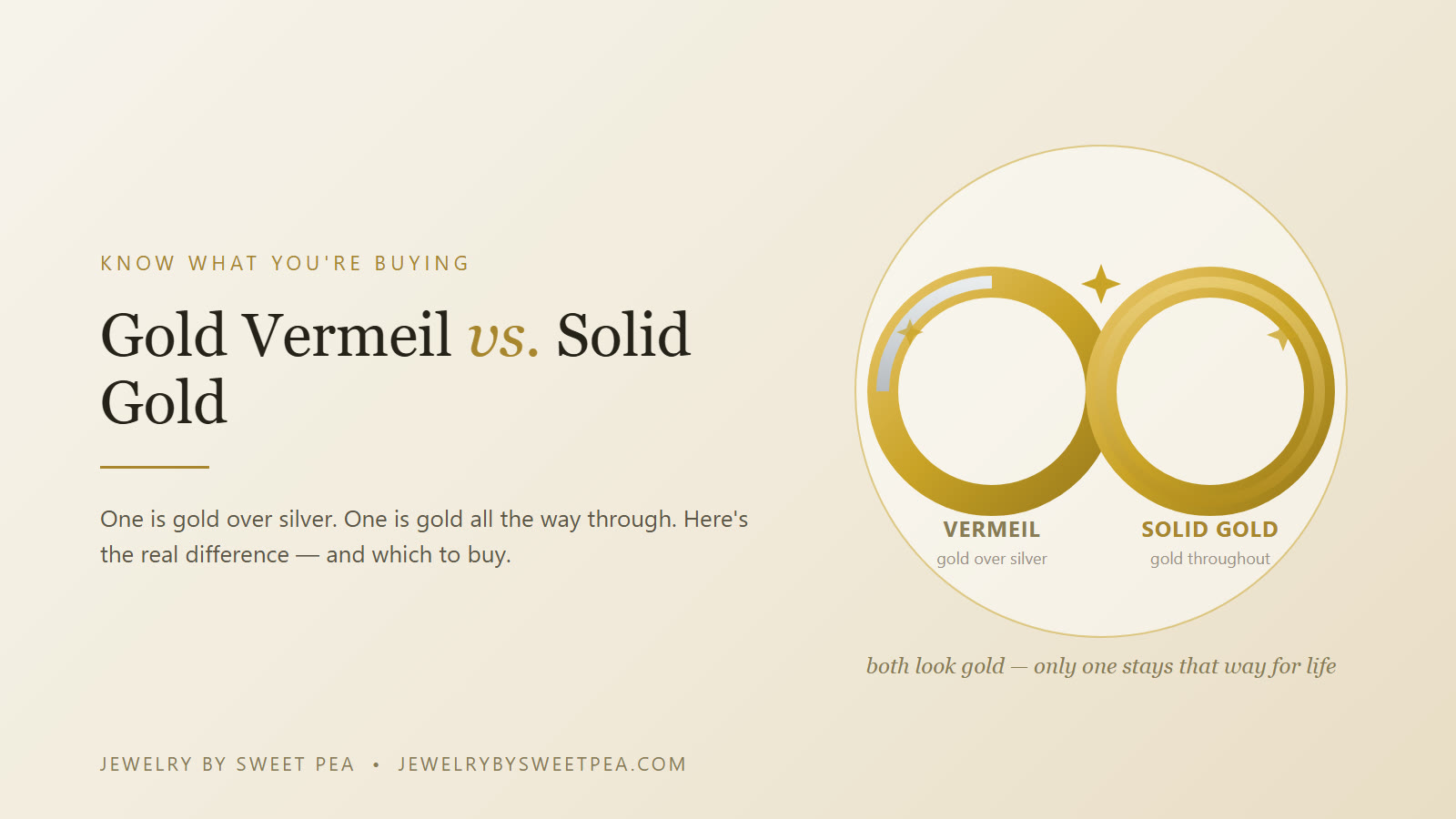
The short answer: gold vermeil is sterling silver coated in a thick layer of real gold, while solid gold is gold alloy all the way through. Vermeil costs less and looks identical when new, but the gold layer wears away over years of wear. Solid 10K or 14K gold never wears off, can be repaired, and holds its value — so vermeil suits trend pieces, and solid gold is the one to buy for anything you'll wear every day.
“Is this real gold?” is the question we hear most, and vermeil is exactly why it's confusing. Vermeil is real gold — just not all the way down. Here's what actually separates the two, in plain terms, so you can spend your money where it counts.
What is gold vermeil, exactly?
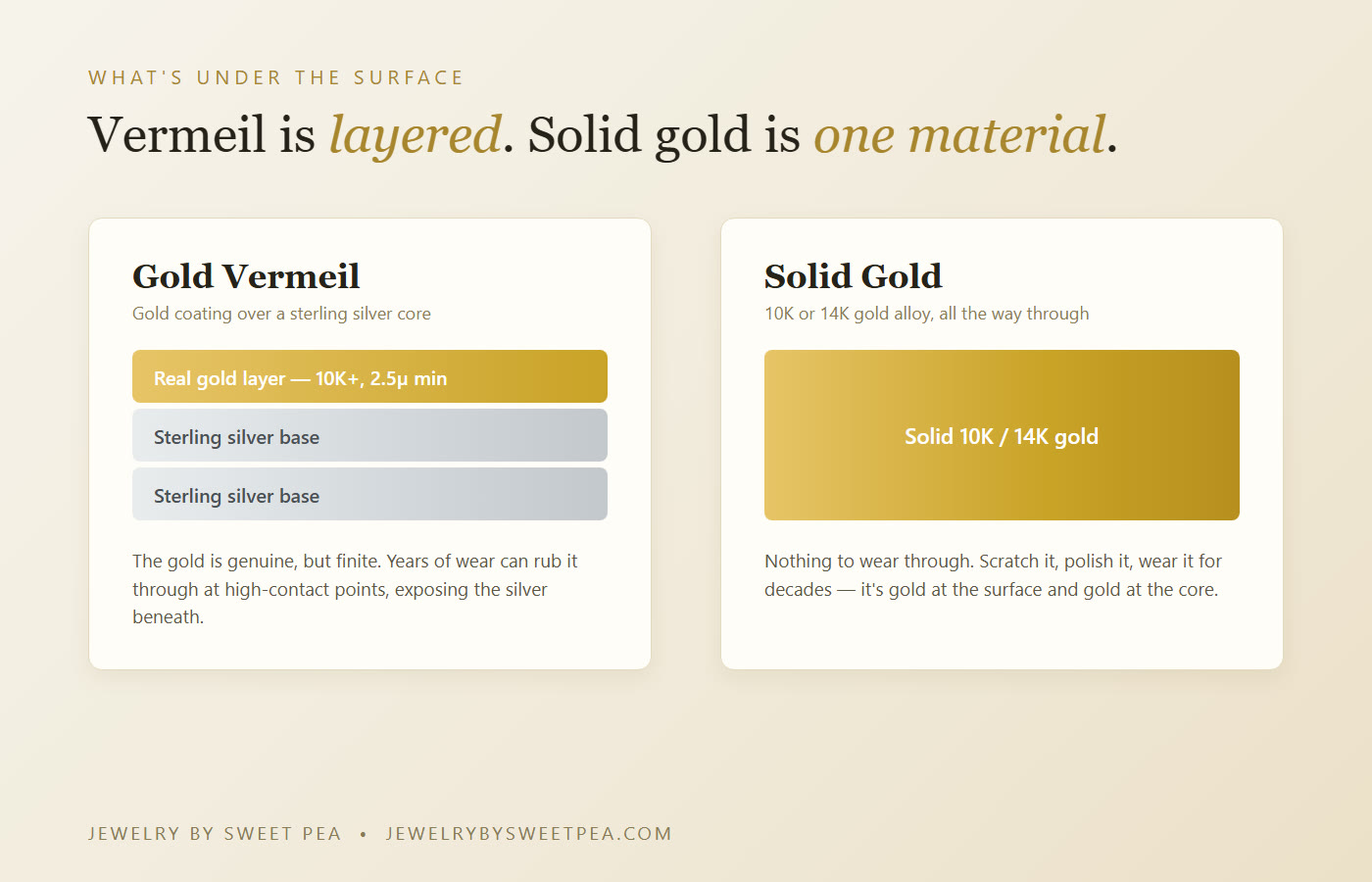
Gold vermeil (pronounced ver-MAY) is a specific, legally defined product — not a marketing word a seller can sprinkle on anything. In the United States, the Federal Trade Commission's Jewelry Guides (16 CFR Part 23) say a piece can only be called “vermeil” if it meets three conditions: the base metal is sterling silver, the gold layer is at least 10K, and that layer is at least 2.5 microns thick.
That thickness is what sets vermeil apart from ordinary gold plating. A standard gold-plated piece might carry a coating measured in fractions of a micron — enough to look gold in the box, not enough to survive a year on your wrist. Vermeil's thicker layer over a genuine silver core is why it feels like a real upgrade over costume jewelry. It is a real, quality category. It is simply not solid gold. (If you want the technical background, the encyclopedia entry on vermeil covers the history and the standards.)
What does “solid gold” really mean?
Solid gold means the entire piece is a gold alloy — there is no other metal hiding underneath. The karat number tells you the purity: 14K is 58.3% pure gold, 10K is 41.7% pure, with the balance made of alloy metals that add strength and color. Pure 24K gold is too soft for daily jewelry, which is why 10K and 14K are the everyday standards.
The key point: with solid gold, there is nothing to wear through. Scratch it, polish it, wear it for forty years — it's gold at the surface and gold at the core. That's the whole difference in one sentence.
Vermeil vs. solid gold: the differences that actually matter
Longevity
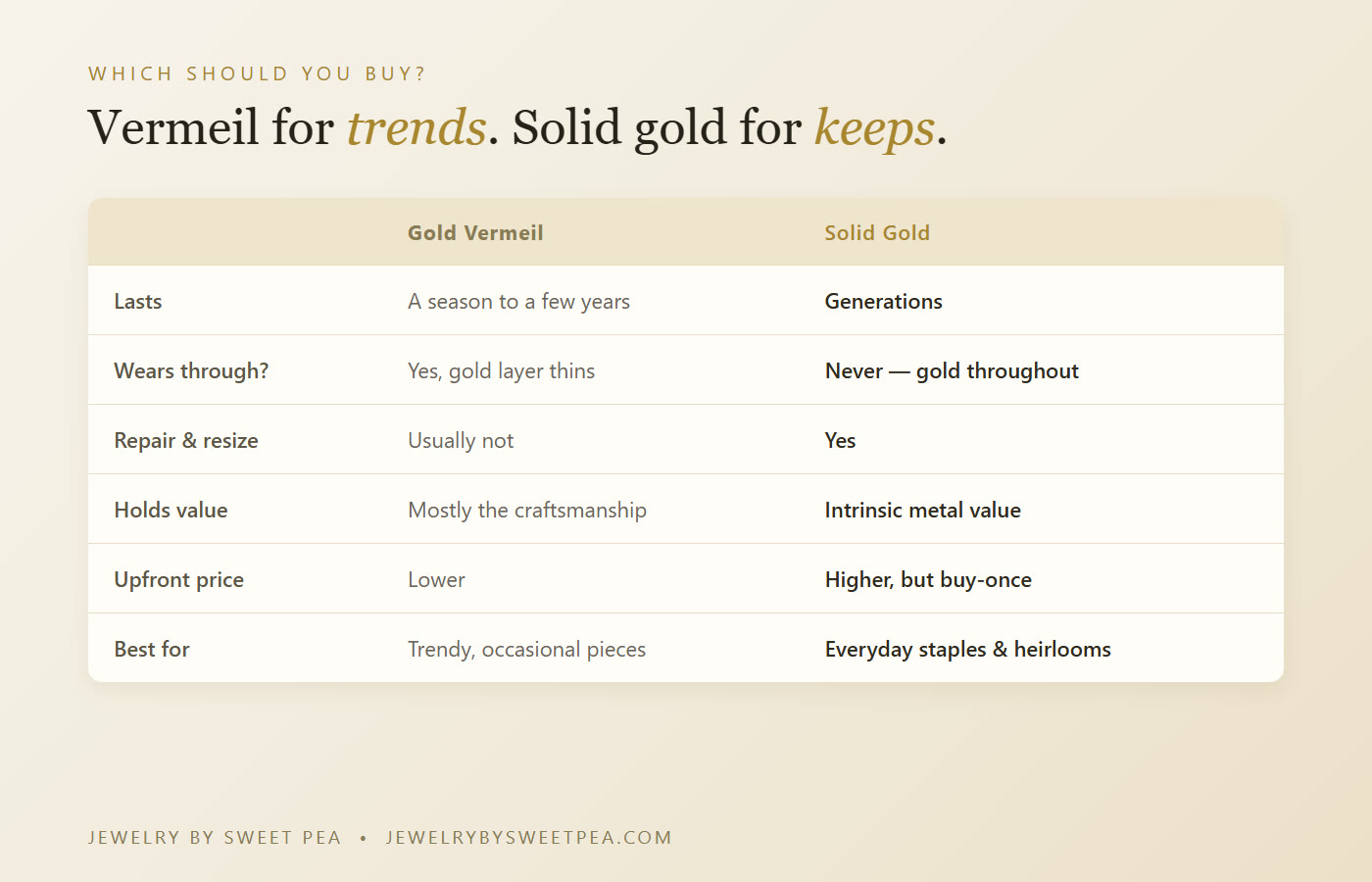
This is the big one. A vermeil gold layer, however thick, is finite. With daily wear — skin oils, lotions, friction against clothing — it gradually thins and eventually rubs through at high-contact points, showing the silver beneath. Depending on how often you wear it, that can happen in a couple of years. Solid gold has no layer to lose. A solid 10K or 14K piece routinely outlives the person who bought it.
Repair and resizing
A solid gold ring can be sized up or down, and a broken solid gold chain can be soldered, because it's gold throughout. Vermeil generally can't be safely reworked — the heat of a jeweler's torch damages the plating, and any repair exposes or removes the gold layer. When vermeil wears out, it's usually replaced, not fixed.
Tarnish and skin reactions
While the gold layer is intact, vermeil resists tarnish. Once it wears through, the exposed sterling silver can tarnish and, for some people, react with the skin. Solid gold is far more stable, and higher karats are a common choice for sensitive ears and necks.
Value
Solid gold carries intrinsic value — the metal itself is worth something, and that floor rises and falls with the gold market. Vermeil's value is mostly in its craftsmanship and the small amount of gold in the coating; it isn't something you keep as a store of value.
Price
Here's the honest trade-off in vermeil's favor: it costs a fraction of solid gold. A vermeil statement piece might be $60–$120 where the solid gold equivalent is several hundred. If you love a bold, of-the-moment design you'll wear for a season or two, vermeil lets you have it without a big commitment.
So which should you buy?
It comes down to one question: how long do you want it to last?
Choose vermeil for trend-driven pieces — a chunky statement necklace, a season's favorite earring shape, something you're trying out. You get the real-gold look at a fashion price, and you won't mind replacing it when styles move on.
Choose solid gold for anything you'll wear constantly or want to keep: everyday earrings, a chain you never take off, a pendant that means something, a gift meant to last. This is where plated pieces disappoint and solid gold quietly earns its price. At Jewelry by Sweet Pea, everything we sell is solid 10K or 14K gold or sterling silver — never vermeil, never plated — because these are the pieces meant to stay in the family.
The everyday pieces worth buying in solid gold
These are the workhorses — the items you'll reach for so often that a wearing-through plating would be a false economy:
- Hoops. The most-worn earring there is. Our 14K Yellow Gold Hoop Earrings (about $201) are the classic choice; the 14K Rose Gold Hoops (about $206) add a warm modern tone. Solid gold means they can be worn to the gym, in the shower, and to sleep for years without a hint of wear.
- A fine gold chain. The piece that layers with everything. A solid 14K Yellow Gold Rope Chain with Barrel Bead (about $243) has an adjustable 16–18 inch length and won't ever fade at the clasp where plated chains give out first.
- A meaningful pendant. Something you'll wear daily, like a solid 10K Yellow Gold Cross Pendant (about $162). Because it's solid, it can be handed down without ever needing to be re-plated.
The budget-friendly solid-gold option
If the appeal of vermeil is the lower price, know that solid 10K gold often lands closer than people expect. A pair of 10K White Gold Hoop Earrings runs about $151 — more than a vermeil hoop, but it's the last pair you'll buy instead of the first of several. Over a few years, the solid pair is frequently the cheaper choice.
Prices shown are at the time of writing; solid gold pieces move with the gold market. Browse more in our Earrings, Necklaces, and Pendants & Charms collections.
How to tell what you're actually buying
Whether you shop with us or anywhere else, three quick checks protect you:
- Look for the karat stamp. Solid gold is stamped 10K, 14K, 18K (or 417, 585, 750). Vermeil and plated pieces are not — and a reputable seller will say “vermeil” or “gold-plated” plainly rather than just “gold.”
- Read the metal line, not the photo. “Gold” and “gold-tone” are worlds apart. If a listing won't state the karat or admits “gold over silver,” that's vermeil or plating — fine, as long as the price and the label match.
- Mind the price. A “14K gold” necklace for $30 is not solid gold. Solid gold tracks the metal market; a price far below that is telling you what's really underneath.
Frequently asked questions
Is gold vermeil real gold?
Yes — the outer layer is genuine gold, at least 10K and at least 2.5 microns thick over a sterling silver core, per the FTC's definition. It is real gold, just not solid gold. The distinction matters because the gold is a coating that can eventually wear through, not the whole piece.
How long does gold vermeil last?
It depends entirely on wear. A vermeil piece worn occasionally can look great for years; one worn daily — especially rings and bracelets that rub against surfaces — may show the silver beneath in a couple of years. Removing it before showering, exercising, and applying lotion extends its life. Solid gold has no such limit.
Is vermeil better than gold-plated?
Yes. Both are gold over another metal, but vermeil is held to a legal standard — a sterling silver base and a thicker (2.5+ micron) gold layer — while ordinary gold plating can be far thinner over cheaper base metals. Vermeil is the higher-quality plated category, but it still isn't solid gold.
Which is better for sensitive skin, vermeil or solid gold?
Solid gold, especially 14K, is the safer bet for sensitive skin because there's no coating to wear away and expose a reactive base metal. Vermeil is fine while the gold layer is intact, but once it wears through, the sterling silver underneath can bother some wearers.
Should I buy vermeil or solid gold?
Buy vermeil for trendy, budget-friendly pieces you'll wear for a season or two. Buy solid 10K or 14K gold for everyday staples and anything you want to keep or pass down — hoops, a fine chain, a meaningful pendant. For pieces you'll actually live in, solid gold is usually the smarter long-term value.
Jewelry by Sweet Pea is a family-run fine jewelry store. Every piece is solid 10K or 14K gold or sterling silver — never vermeil, never plated — sourced from U.S. wholesalers and shipped from the USA. Browse our gold collection or ask us anything before you buy.