
Jewelry Professionals Explain Ring Sizing and How to Find Her Size Without Asking
The short answer: borrow a ring she already wears on the finger you are buying for and measure its inside diameter in millimeters — that one number gives you her size. If you cannot get hold of one, ask her mother or closest friend, buy adjustable, or size up rather than down. A slightly loose ring can be worn today and made smaller later; one that will not clear the knuckle cannot.
Sizing is the one part of buying jewelry where being off by a hair ruins an otherwise perfect gift. It is also the easiest part to get right, once you know what the number measures.
What does a ring size actually measure?
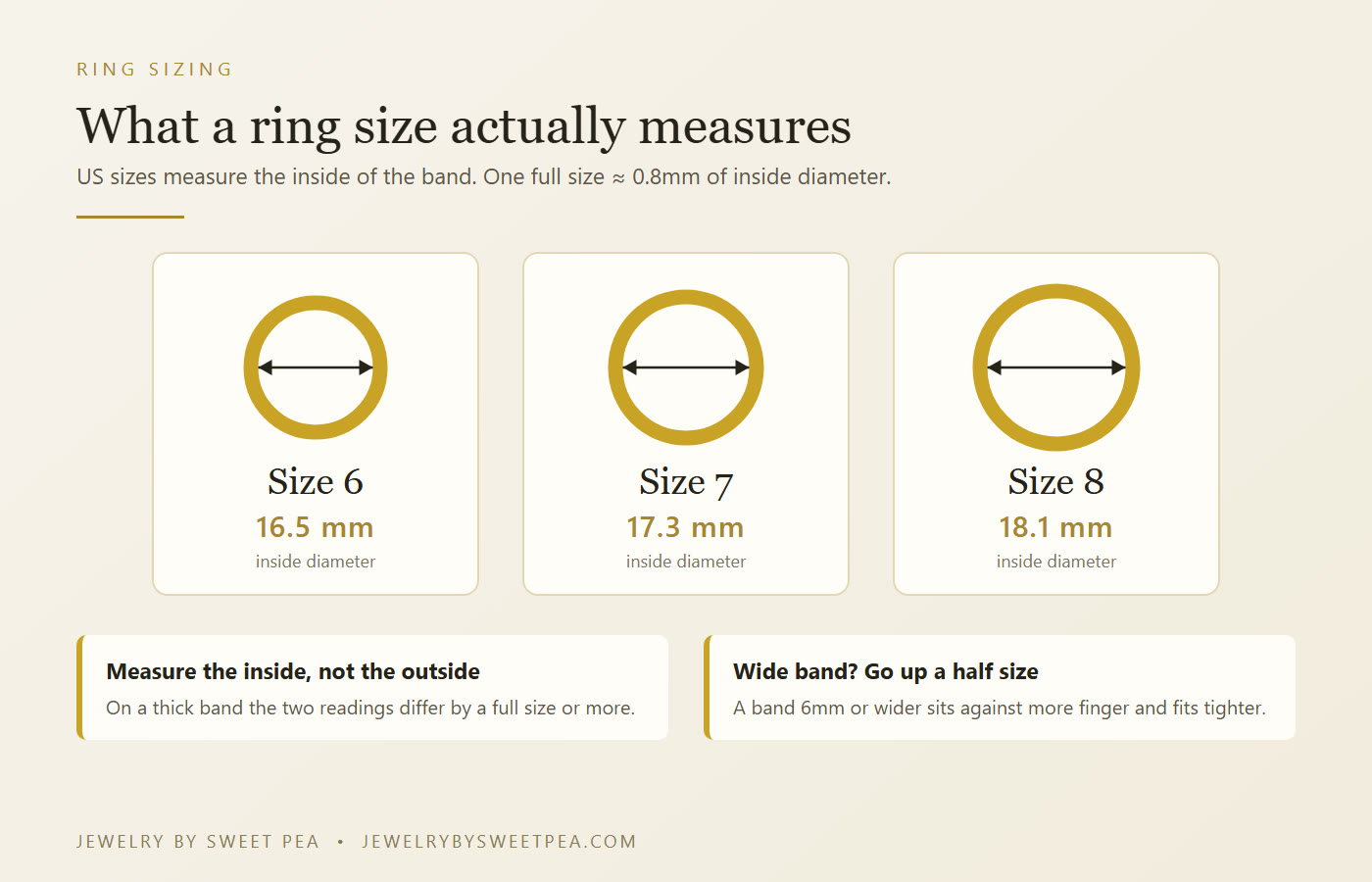
A US ring size measures the inside circumference of the band, not the width of her finger. One full size is about 2.55mm of circumference, or roughly 0.8mm of inside diameter — small enough that a half size is a real difference you can feel, and large enough that a full size off is immediately obvious.
The three numbers worth memorizing, as inside diameter:
- Size 6 — about 16.5mm across the inside
- Size 7 — about 17.3mm
- Size 8 — about 18.1mm
Lay one of her rings on a ruler, read the inside edge to edge, and you have placed her within a half size with no special tool. Measure the inside, not the outside — on a thick band those two readings differ by a full size or more.
And one thing jewelers know that shoppers usually do not: band width changes the fit. A wide band feels tighter than a thin one of the same size, so on anything 6mm or wider, go up a half size.
How do I find her ring size without asking her?
Five methods, in the order we would actually try them.
1. Borrow a ring she already wears. The most reliable method by a wide margin. Take one from the same finger you are buying for, measure the inside diameter against a ruler, and match it to the numbers above. Hand it to a jeweler if you want it read exactly — it takes ten seconds on a mandrel.
2. Trace the inside on paper. If the ring cannot leave the house, set it on paper and draw carefully around the inside opening with a sharp pencil, then measure your circle. Less precise than a mandrel, but within a half size if you are careful.
3. Press it into a bar of soap. An old bench trick, and a good one. Push the ring flat into fresh soap or modeling clay and you have an impression you can measure at leisure, with the ring back where you found it.
4. Ask the person who would know. Her mother, her sister, her closest friend. This feels like cheating and it is the highest-accuracy option on the list, because someone in her life has almost certainly bought her a ring before.
5. Note which finger, and which hand. Ring fingers, index fingers and thumbs are nowhere near each other, and the dominant hand usually runs a quarter to a half size larger. A borrowed ring only tells you the truth about the finger it came from.
The one method we would skip: wrapping string around her finger while she sleeps. String stretches, paper bites in, the reading changes with how hard you pull — and it wakes people up.
What if I have nothing to go on at all?
Then guess deliberately rather than blindly. Most adult women's rings land in the size 6 to 7 range — you can see it in how stock gets bought, since the sterling stackable rings we carry arrive from our supplier in size 6. With nothing else to go on, 7 is the safer end of that band.
Also worth knowing: fingers change size during the day. They are smallest in the morning and in cold weather, largest at the end of a hot day or after a salty meal. Measure in the evening at room temperature — that is the size the ring has to fit.
Which rings can be resized, and which cannot?
Worth answering before you buy rather than after, because it decides how much your guess matters.
Usually straightforward: plain bands, and rings with stones only across the top, in solid 10K or 14K gold or solid sterling silver. A bench jeweler can move most of these a size or two in either direction.
Usually difficult or impossible: eternity bands with stones all the way around, channel-set rings, tension settings, and any ring with stones running down the sides of the shank. There is nowhere to cut and nothing to add without disturbing the setting. Rings with a non-metal inlay, and bands already very thin, belong in the same column.
Solid metal is what makes resizing possible at all. A plated ring — base metal under a microscopically thin layer of gold — cannot be worked on without cutting through the finish, one of several reasons everything we sell is solid 10K or 14K gold or solid sterling silver. For the legal definitions behind “solid gold,” “gold filled” and “gold plated,” the FTC's jewelry rules at 16 CFR Part 23 are the source.
Which rings do not need a size at all?
Sometimes the honest answer is to sidestep the problem. Adjustable rings have an open back that flexes, so one ring covers several sizes — the right call when you cannot measure, and for anyone whose fingers swell in summer. Stackable rings are thin enough that a half size off reads as a styling choice, and they are meant to be worn two or three at a time, so a snug one simply moves to another finger.
What we would actually buy, by price
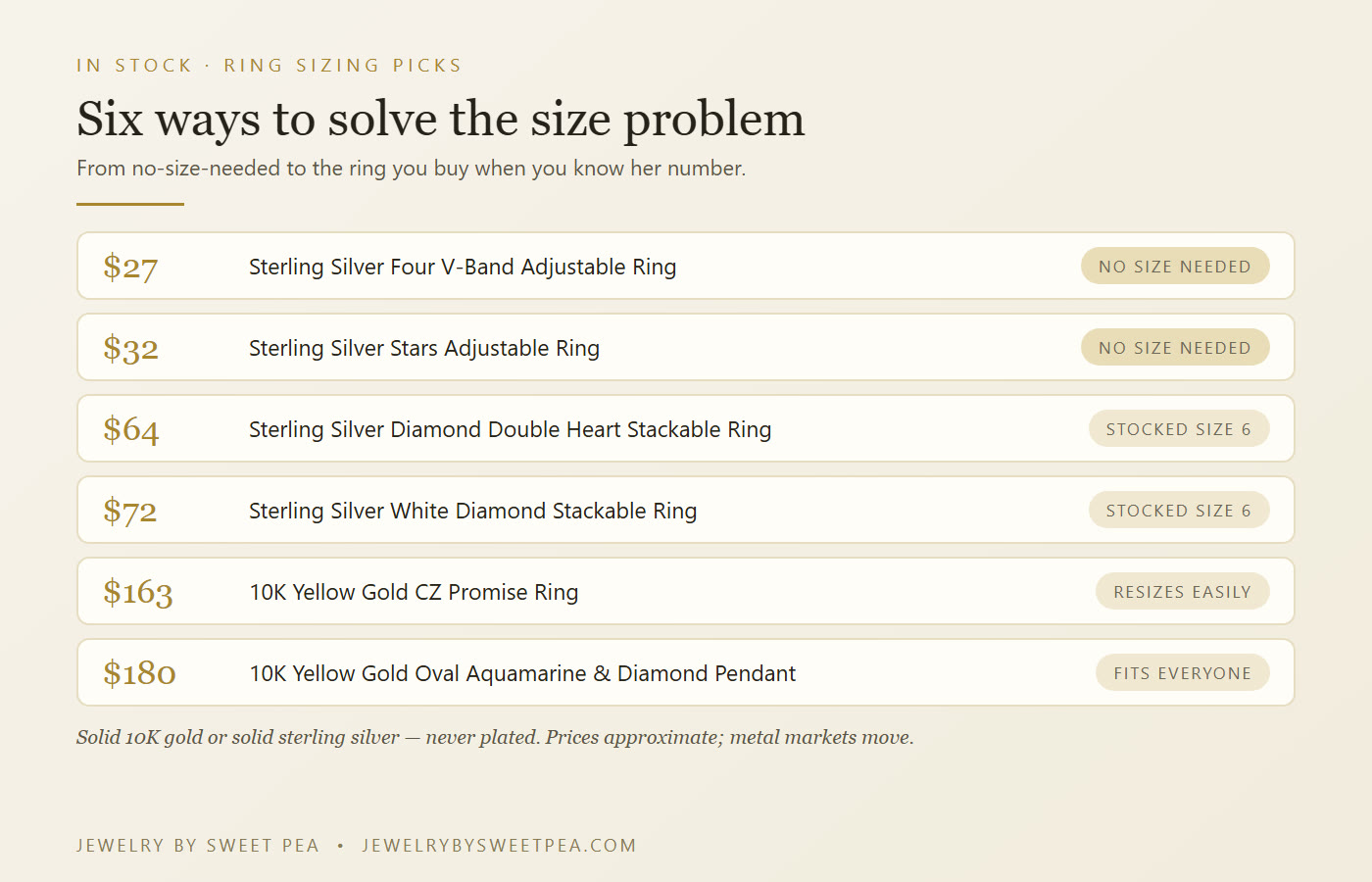
All six are in stock as this is written. Metal prices move, so treat these as close rather than exact.
Sterling Silver Four V-Band Adjustable Ring — about $27. Four fine bands that read as a stack but arrive as one adjustable piece. The lowest-risk ring on this page.
Sterling Silver Stars Adjustable Ring — about $32. The same no-size logic with more personality. Both of these are solid sterling finished with rhodium — an anti-tarnish treatment on top of solid silver, not plating over base metal.
Sterling Silver Diamond Double Heart Stackable Ring — about $64. Real diamond accents on a band thin enough to forgive a half size. Stocked in size 6.
Sterling Silver White Diamond Stackable Ring — about $72. The plainer stackable, and the one that layers with whatever she already owns. On what separates one small diamond from another, GIA's diamond quality factors is the reference we point people to.
10K Yellow Gold CZ Promise Ring — about $163. Solid 10K gold with stones across the top only — exactly the construction a jeweler can resize comfortably. The pick for when you do know her size.
10K Yellow Gold Oval Aquamarine and Diamond Pendant — about $180. Not a ring, deliberately. If the size question has no good answer and the occasion will not wait, a pendant fits everyone. More in pendants and charms, or see the full rings collection.
What happens if the size is still wrong?
On website orders, two things cover you, and both are on our return policy page: a 30-day money-back guarantee with a prepaid, insured return label, and one complimentary resizing on eligible rings within the first year — you cover insured shipping to us, and we size it and send it back at our cost. Do those in the right order, though: a resized ring is no longer returnable, so if you are unsure about the ring itself rather than the fit, return first and resize second.
If you know before it ships that the size is wrong, say so in the Comments box at checkout and we will tell you what is possible on that specific ring — some can be ordered in another size, some cannot. One caveat: orders placed through Walmart, Amazon or eBay follow that marketplace's return process rather than ours, and those listings are stock sizes only.
Frequently asked questions
How can I measure her ring size without her knowing?
Borrow a ring she wears on that finger and measure the inside diameter, or press it into a bar of soap and measure the impression later. Both leave no trace. Asking her mother or closest friend is the most accurate option of all.
Is it better to buy a ring too big or too small?
Too big. A loose ring can be worn immediately and sized down later; a ring that will not pass the knuckle cannot be worn at all, and the disappointment lands in exactly the moment you were hoping to make.
What is the most common women's ring size?
Most adult women fall between a 6 and a 7, which is why size 6 is the standard stocking size for thin sterling bands. Treat it as a starting point, not an answer — individual hands vary a great deal.
Can any ring be resized?
No. Plain bands and rings with stones only across the top are usually straightforward. Eternity bands, channel settings, tension settings and rings with stones down the sides often cannot be resized at all. Ask before you buy if the size is a guess.
Does a wide band need a different size?
Yes. Wide bands fit more snugly than thin ones at the same size, so on a band 6mm or wider, go up a half size from her usual number.