Should You Buy a Birthstone Ring or a Birthstone Necklace When Shopping for a Meaningful Gift
The short answer: choose a birthstone necklace when you are not sure of her ring size, when the gift is a surprise or when she works with her hands. Choose a birthstone ring when you know her size and she already wears rings every day. A pendant is the safer gift; a ring is the more personal one.
We are a small, family-run jewelry store, and this is one of the questions we hear most when someone wants a gift that says "I thought about you." Both are lovely. The right one depends less on the stone and more on how she lives and what you already know about her. Here is how we help families decide.
What is the real difference between a birthstone ring and a birthstone necklace?
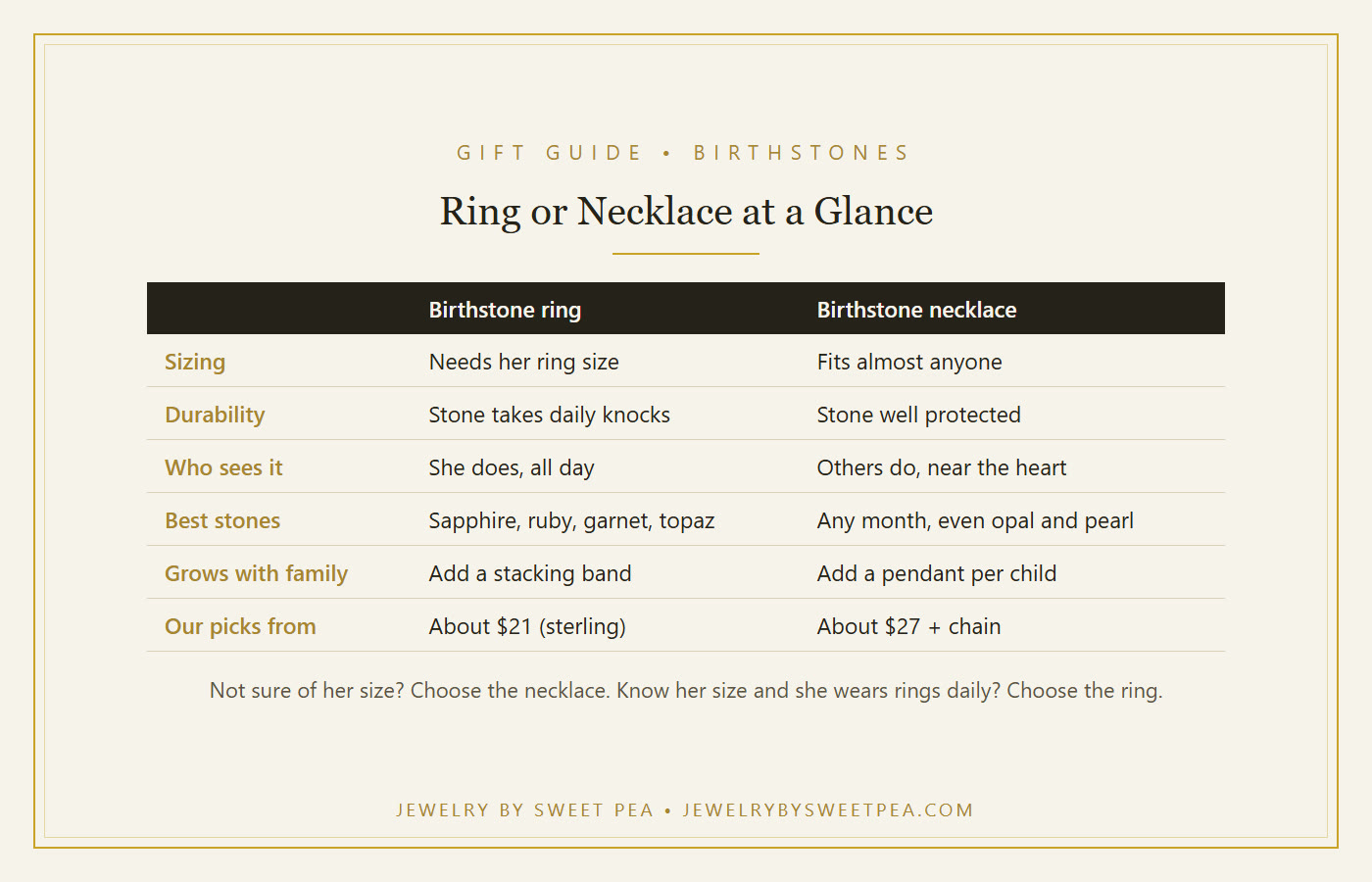
The stone can be exactly the same. What changes is how the piece is worn, how it is sized and how much wear the stone takes.
- A ring sits on the hand. She sees it all day, every time she reaches for something. That makes it feel personal, and it also means the stone bumps into counters, steering wheels and door handles.
- A necklace sits near the heart. Others notice it more than she does, and the stone is far better protected. Pendants rarely get knocked around the way rings do.
- A ring needs a size. A pendant only needs a chain length, and most chain lengths work for most people.
- A pendant can grow. Many families add a second or third birthstone pendant over the years, one for each child or grandchild, and wear them together on one chain or on layered chains.
When is a birthstone necklace the better gift?
A pendant is our usual recommendation when any of these are true:
- You do not know her ring size. Guessing wrong means a resize or an exchange, and a surprise that does not fit can take the shine off the moment.
- She works with her hands. Nurses, teachers, cooks, gardeners and new moms often take rings off all day long. A necklace stays on.
- The stone is on the softer side. Opal (October) and pearl (June) are delicate, and even garnet and topaz can chip if struck hard. A pendant keeps them out of harm's way.
- It is for a teen or a growing girl. Fingers change size through the teen years; a chain simply fits.
- You want to build a family piece. A mother's or grandmother's necklace can start with one stone and add more as the family grows.
One practical note: many birthstone pendants, including the ones below, are sold as the pendant only, so plan to add a chain. A fine 18-inch sterling or gold chain suits most women and lets the stone rest just below the collarbone.
When is a birthstone ring the better gift?
A ring makes sense when you can answer yes to most of these:
- You know her size, or you can borrow a ring she already wears on the same finger and measure it with our ring size guide.
- She already wears rings daily and has a "right-hand ring" spot open.
- The stone is durable. Sapphire, ruby and diamond are the toughest birthstones. Garnet, amethyst, topaz and peridot are fine for rings with a little care.
- You want her to see it. A ring is the gift she will look down at a hundred times a day, which is exactly why it can feel so meaningful.
A tip from the counter: if you are close but not certain on size, go a quarter or half size up rather than down. A slightly loose ring is easier to live with, and to adjust, than one that will not go over the knuckle.
Which birthstones hold up best in a ring?
Gems are rated on the Mohs hardness scale, where higher numbers resist scratching better. The Gemological Institute of America's birthstone guide is a good place to look up any month. In plain terms:
- Very tough for rings: diamond (April), ruby (July), sapphire (September).
- Good for rings with care: garnet (January), amethyst (February), aquamarine (March), emerald (May, which can have inclusions that make it more fragile), peridot (August), topaz and citrine (November), blue topaz, zircon and tanzanite (December).
- Better as a pendant or earrings: pearl and moonstone (June), opal (October), turquoise (December).
Whatever you choose, look at how the stone is described. Under the FTC's Guides for the Jewelry, Precious Metals, and Pewter Industries, a lab-created or imitation stone should be labeled as such, and so should treatments that make a real difference to value or care. Crystal or glass "birthstone colors" are fine fashion pieces, but they are not the gemstone itself. For example, most blue topaz on the market gets its color from treatment, which is normal and stable but worth knowing, as GIA explains on its topaz page.
Birthstone ring vs. necklace: our picks
Prices float with metal and gem markets and our everyday pricing, so treat these as "about" figures and check the product page for today's price.
Birthstone rings
- Sterling silver garnet heart ring, about $21. A natural garnet heart for a January birthday, polished sterling with a bright rhodium finish.
- Sterling silver garnet and CZ swirl ring, about $24. A little sparkle around the stone for someone who likes a dressier look.
- Sterling silver Swiss blue topaz ring, about $24. A clean, simple ring for a December birthday.
- Shey Couture sterling silver and 14K gold rhodolite garnet heart ring, about $32. Antiqued detail and a touch of gold for a more heirloom feel.
Birthstone pendants
- Sterling silver floral garnet pendant, about $27. A sweet flower setting; chain sold separately.
- Sterling silver floral amethyst pendant, about $27. The same design for a February birthday, so sisters or a mother and daughter can match.
- Sterling silver garnet and diamond oval slide pendant, about $30. A diamond accent makes this one feel a step dressier.
- Sterling silver sky blue topaz pendant, about $34. Light, bright blue that goes with everything.
- 14K yellow gold garnet bezel slide pendant, about $45. Solid 14K gold with the stone wrapped in a protective bezel, a lovely first gold piece.
Browse more rings, pendants, chains to go with them, necklaces and our gift ideas.
What should you spend on a birthstone gift?
- Under $30: a sterling silver birthstone ring (about $21 to $24) or a sterling floral pendant (about $27). Real gemstones, real sterling, easy on a family budget.
- $30 to $60: the Shey Couture heart ring (about $32), the garnet and diamond slide (about $30) or the blue topaz pendant (about $34) plus a sterling chain.
- Solid gold: the 14K gold garnet bezel slide (about $45), paired with a 14K gold chain from our chains page. This is the pendant she can wear every day for decades.
Not sure about the month? Matching sterling silver 4mm garnet stud earrings (about $22) make an easy add-on, and earrings never need a size either.
How do you make a birthstone gift feel more meaningful?
- Use the right month for the right person. A mother may love her children's birthstones more than her own.
- Write a short card saying why you chose that stone or that month.
- Plan for the future. A pendant can become the first piece of a collection; a ring can be joined by a matching stackable band later.
- Keep the receipt and check the return policy, especially on rings, in case the size needs to change.
Frequently asked questions
Is a birthstone ring or necklace a better gift for mom?
For most moms we suggest a necklace. It needs no ring size, stays on through busy days, and you can add a birthstone for each child over time. If she already wears a right-hand ring every day and you know her size, a birthstone ring is a wonderful, personal alternative.
What if I do not know her ring size?
Choose a pendant or earrings instead, or borrow a ring she wears on the same finger and measure it with a ring size guide. If you must guess, go slightly larger rather than smaller, and keep the receipt in case it needs to be exchanged or resized.
Which birthstones are too soft for everyday rings?
Pearl, moonstone, opal and turquoise are the most delicate birthstones and are better worn as pendants or earrings. Diamond, ruby and sapphire are the toughest, and garnet, amethyst and topaz do well in rings with sensible care.
Do birthstone pendants come with a chain?
It depends on the piece. Many pendants, including the ones we feature here, are sold as the pendant only, so check the listing and add a chain. An 18-inch chain suits most women; 16 inches sits higher at the collarbone.
Are birthstone colors the same as real birthstones?
Not always. Crystal or glass in a birthstone color is a fashion piece, while a genuine birthstone is the actual gem, such as garnet for January. Lab-created stones are real gem material grown in a lab and should be labeled that way. Read the description so you know which one you are buying.