
What Jewelry Buyers for Major Retailers Look for When Selecting Pieces to Sell
The short answer: Buyers for large retailers pick jewelry that will sell through, hold up, and come back in stock. In practice that means classic shapes (studs, hoops, chains, pearls, bangles), solid metal that is marked and disclosed the way the FTC guides require, secure clasps and settings, a clear price ladder from entry to anchor, and a maker who can ship the same piece again next season. Shoppers can use the same checklist.
We're a small, family-run jewelry store, not a department-store buying office. But we buy from the same manufacturers those buyers use, we walk the same trade-show aisles, and we ask the same questions before a piece earns space in our case. This roundup gathers the criteria that come up again and again, in the order buyers tend to weigh them. None of it is secret. Most of it is just discipline.
What is a retail jewelry buyer actually judging?
A buyer is not asking "is this pretty?" They are asking "will this sell at the price we need, without coming back?" That question breaks into a few parts:
- Sell-through. Will the piece move in a normal season at full price, not only on clearance? Proven shapes score here.
- Margin at the shelf price. The piece must land at a price customers accept while leaving room for the store. Gold weight, stone cost and labor set the floor.
- Quality and compliance. Correct karat marking, honest descriptions, sturdy construction. Problems here become returns and complaints.
- Wearability. Does it sit well, stay closed, and survive daily life? Pieces that snag, flip or pinch get returned.
- Consistency of supply. Can the maker ship the same item, same quality, next month and next year? One-off lots are risky for a chain of stores.
- Return risk. Sizing, fragility and "it looked bigger online" all drive returns, and buyers try to design them out.
Why do buyers keep choosing the same classic shapes?
Walk any national jewelry counter and you'll see the same families: diamond studs, gold hoops, a plain chain, a strand or pendant of cultured pearls, a bangle. That's not a lack of imagination. Those shapes have sold for decades, they fit most ages and outfits, and customers already know what they are. A buyer can forecast them. A novelty piece might be the star of one season and dead stock the next, so it gets a small, careful order, while the classics get the deep one.
For a shopper, this is useful information: the pieces that are easiest to buy with confidence are the pieces buyers order in depth. They are also the ones easiest to repair, match and resell later. Our earrings, chains, pearls and bracelets collections are built around those same families for that reason.
What quality checks happen before a piece gets a SKU?
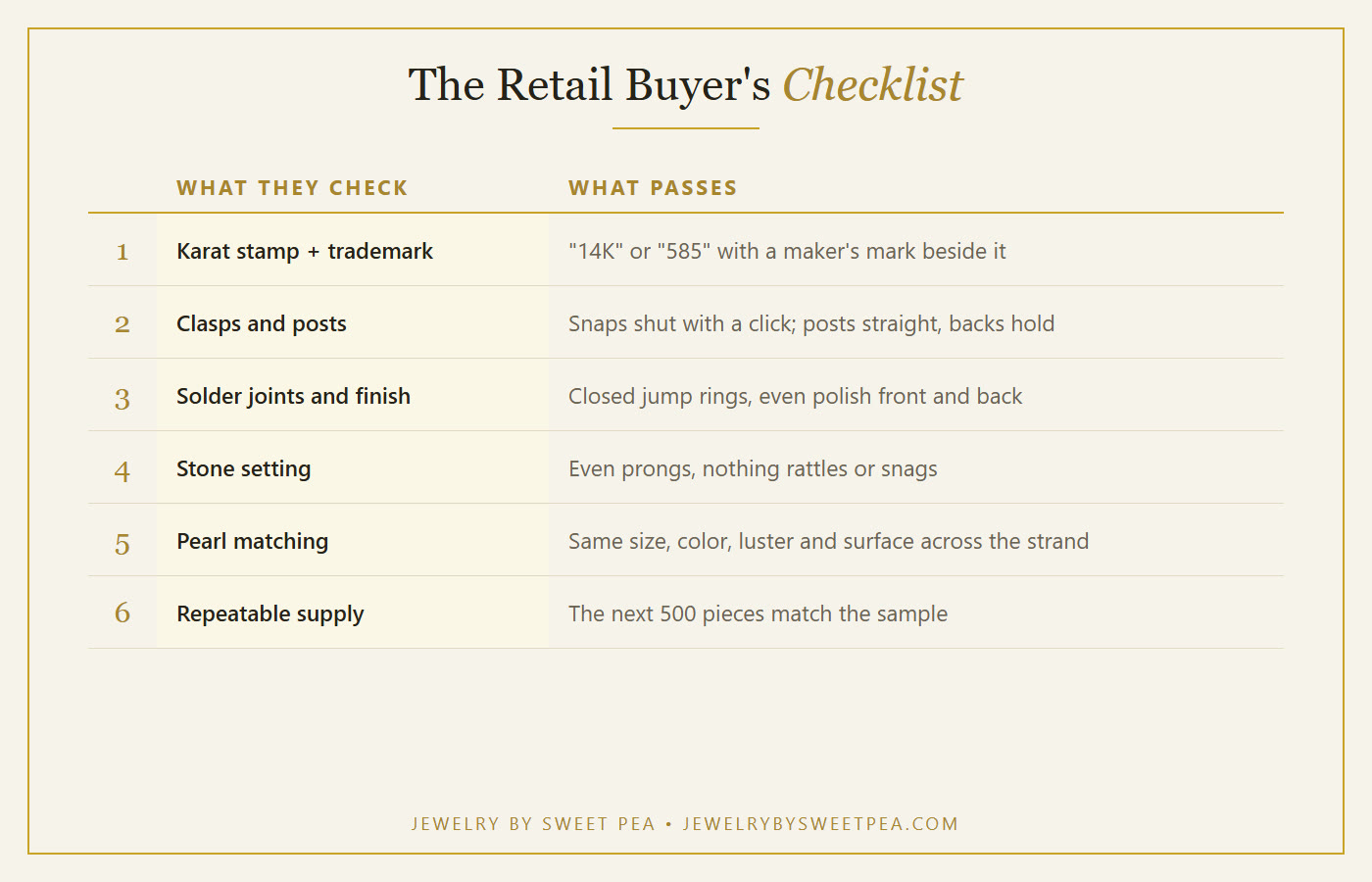
Here is the inspection a careful buyer runs, and that you can run at a counter or when a package arrives:
- Karat stamp and trademark. In the United States, the FTC's Jewelry Guides (16 CFR Part 23) describe how gold content and plating must be disclosed. Buyers look for a correct karat mark ("14K" or "585") and expect a maker's trademark next to it. "Gold" with no karat, or "gold" that turns out to be plating, is a hard no.
- Clasps and posts. Lobster and spring-ring clasps should snap shut with a clean click. Earring posts should be straight and the backs should hold. Hinged hoops should close flush with no gap.
- Solder joints and finish. Jump rings closed, no pits or rough edges, polish even on the back as well as the front. A buyer will turn the piece over first.
- Stone setting. Prongs that cover the stone evenly and don't catch on fabric; stones that don't rattle. For diamonds, the grading basics in the GIA's diamond quality factors are the shared language between maker and buyer.
- Pearl matching. On a strand or a pair, pearls should match in size, color, luster and surface. The GIA's pearl quality factors describe exactly what buyers compare.
- Repeatable supply. The buyer asks whether the next 500 pieces will match the sample. For a shopper, the parallel is simple: a piece from an established maker is easier to match, repair or replace later.
How do buyers build a price ladder?
Retail buyers rarely pick single items. They build a ladder so a customer at any budget finds a "yes." The rungs below are typical for solid gold and sterling, using our own live prices as examples. Gold prices float daily, so treat every number as "about."
| Rung | What sits there | Typical pieces |
|---|---|---|
| Entry (about $40 to $70) | Sterling silver, small 14K charms | Compass or initial pendants, a single pearl pendant |
| Everyday gold (about $80 to $150) | Light solid 14K | Twist hoops, small lab-grown studs, a fine cable chain |
| Step-up (about $150 to $300) | Heavier gold, cultured pearls | Freshwater pearl strand, slip-on bangle, Akoya strand |
| Anchor (about $300 and up) | Statement classics | Larger Akoya strands, bigger diamond studs, solid bangles |
Notice what is not on the ladder: plated pieces dressed up as gold, chains so thin they kink in a week, or trend items with no repeat demand. Buyers leave those off because they come back.
Which pieces pass the buyer's test, with real prices?
Everything below is in stock as we write this, in solid 14K gold or sterling silver, never plated, and priced from the live product page.
Entry rung: under about $70
- Sterling silver nautical compass pendant, about $45. A clean, recognizable design with no fragile parts, which is exactly what a buyer wants at the entry price.
- 14K gold single freshwater cultured pearl pendant, about $59. One well-matched pearl on solid gold. Simple to make consistently, simple to wear.
Everyday gold: about $80 to $150
- 14K gold polished twist hoop earrings, about $86. A classic hoop with a little texture, light enough for daily wear.
- 14K gold 1/10 carat lab-grown diamond stud earrings, about $133. Four-prong settings and a heavyweight post, which is the construction buyers ask for in a stud.
- 14K gold 7-8mm rice freshwater cultured pearl necklace, from about $136. Matched pearls, a real gold clasp, and a length you can choose.
- 14K gold 0.9mm cable chain, 18 inch, from about $147. The workhorse chain under most pendants in any department store case.
Step-up: about $150 to $300
- 14K gold 1.5mm diamond-cut slip-on bangle, about $270. No clasp to fail, solid all the way around, and it stacks.
- 14K gold 7-8mm round Akoya saltwater cultured pearl necklace, from about $281. The strand buyers treat as the pearl benchmark: round, well matched, high luster.
What do buyers turn down, and why?
Rejections tell you as much as approvals. Pieces that usually fail a buyer's review:
- Unmarked or mis-marked metal. No karat stamp, or a stamp with no trademark beside it. Buyers won't take the liability.
- Plating sold as gold. "Gold-plated" and "gold-filled" are legitimate products when labeled correctly, but they are not solid gold, and a buyer won't let them sit next to it unlabeled.
- Weak construction. Hollow tubing that dents, prongs that catch, posts that bend, clasps that need two hands.
- Sizing traps. Rings in one size only, or bracelets with no adjustment, raise the return rate.
- One-season novelty. Fun to look at, impossible to forecast, so it gets a tiny order or none.
If you're shopping, the same list keeps you out of trouble. Our earlier post on why gifted jewelry gets returned covers the sizing and fit side in more detail.
How can you shop like a buyer?
You don't need a trade badge. Before you buy, do five things: look for the karat mark and a maker's mark; open and close the clasp a few times; turn the piece over and check the finish; ask what the stones or pearls are, in plain words, and whether the metal is solid or plated; and favor shapes you'll still wear in five years. A seller who answers those questions easily is a seller a buyer would work with.
Frequently asked questions
What do jewelry buyers look for first?
Sell-through and margin, together. The piece has to be something customers already want (a classic shape) at a price that works for both the shopper and the store. Quality checks follow right after, because a piece that comes back costs more than it earned.
Do major retailers sell plated jewelry?
Many do, in clearly labeled fashion sections. What buyers refuse is plated or filled metal described as gold. The FTC's Jewelry Guides spell out how gold content and plating must be described, and buyers follow them because mislabeling creates legal and return problems.
Why are diamond studs, hoops and pearls in every store?
Because they sell year after year to a wide range of ages, which makes them easy to forecast and order in depth. They also cost less to make consistently than complex designs, which keeps the shelf price reasonable.
Is a karat stamp enough to prove gold is real?
A stamp is the first check, not the last. Buyers also expect a maker's trademark next to the karat mark and, for larger orders, assay testing. For a shopper, buying from a seller who states "solid 14K gold" in writing and backs it with a return policy is the practical version of that check.
How do I use a buyer's price ladder when shopping?
Decide your rung first, then pick the best-made classic at that rung. Solid sterling pieces start at about $45, light solid 14K gold at about $86, and a cultured pearl strand or gold bangle at about $136 to $281. Spending more buys weight, size or stone quality, not a different category of "real."